
Icynene Attic Insulation: The West Covina Owner’s Guide
If you’ve got Icynene spray foam in your attic and it’s starting to shrink, pull away from the rafters, or you’ve spotted gaps where heat pours through, you’re not stuck with a full re-foam. Walt’s Insulation stocks Icynene-compatible open-cell and closed-cell products, and in most West Covina homes we can match, patch, or reapply the affected section for $1.80 to $3.40 per board foot installed. Same-day or next-day service is available, and we’ll tell you straight if a full section needs to come out or if a targeted reapplication will do the job.
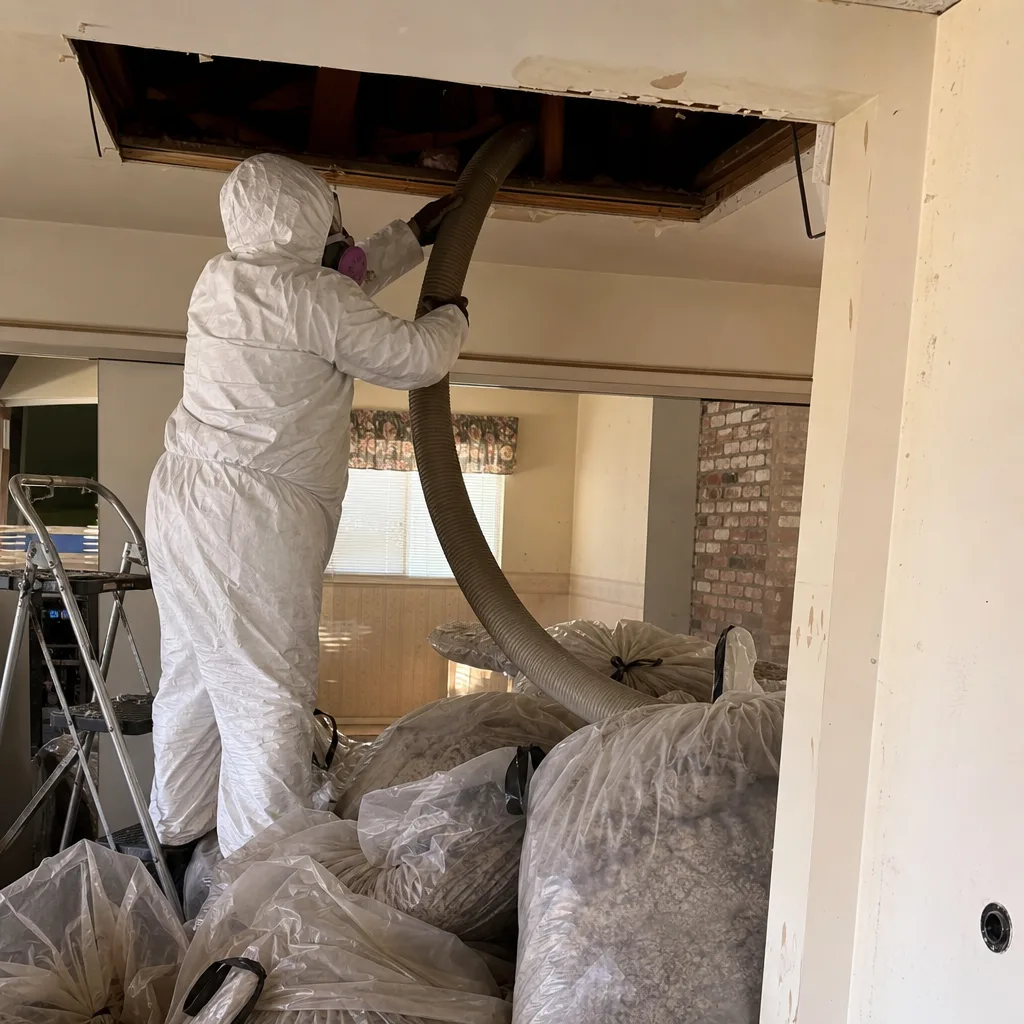
The way most owners discover a problem is not dramatic. It’s a July electric bill that’s $90 higher than last year. Or a bedroom that never quite cools down even when the AC runs all afternoon. Or they poke their head into the attic for the holiday decorations and notice the foam has pulled back from the sheathing, leaving a dark gap you could slide a pencil into. That gap is where your conditioned air escapes, and in West Covina’s summer heat, it works against you every single day.
Which Icynene Models This Applies To
This page covers the two Icynene product families we see most often in West Covina attics: Icynene Classic (open-cell, half-pound foam) and Icynene ProSeal (closed-cell, two-pound foam). If your home was built or retrofitted between roughly 2005 and 2020, there’s a good chance one of these two is what’s up there. The easiest way to tell is to look at the foam itself: Classic is softer, lighter, and has a sponge-like texture you can dent with a thumb. ProSeal is rigid, denser, and has a slicker surface.
One compatibility gotcha we run into regularly: you cannot patch open-cell with closed-cell and expect it to perform. They have different expansion rates, different R-values per inch, and different moisture permeability. If you’ve got Classic up there, the patch has to be open-cell. Mixing them creates an uneven thermal barrier and can trap moisture at the seam. We’ve corrected more than one DIY patch job in the Eastland Center corridor where someone sprayed a can of hardware-store closed-cell foam into an open-cell gap and ended up with a damp, musty corner.
For the OEM-versus-aftermarket question: Icynene’s name is on the original install, but the foam itself is a two-part polyurethane system. We install fresh material from Icynene and Demilec, both of which we trust, and we match the density and cell structure to what’s already in your attic. What matters more than the brand label is that the application is done with proper temperature control and the right thickness. A cheap patch that’s too thin is how you end up redoing the same square footage two years later.
Signs Your Icynene Attic Insulation Is Failing
- Shrinkage or pull-away from the rafters: Over time, poorly mixed or thinly applied open-cell foam can shrink, leaving a visible channel along the wood framing. That channel is a direct thermal bridge between your attic and living space, and it’s the most common issue we find in older West Covina homes.
- Soft or crumbly spots in the foam: Open-cell Icynene should be springy, not powdery. If it’s breaking down into dust or crumbling when touched, the foam was either mixed off-ratio at install or has been exposed to sustained high heat over years of valley summers.
- Musty or stale attic smell: Closed-cell foam shouldn’t absorb moisture, but open-cell can hold it if there’s a roof leak or condensation problem. A lingering damp smell in the attic air is often the first clue that a section of foam is saturated and no longer insulating.
- Hot spots in rooms directly under the attic: Walk your upstairs hallway in the late afternoon. If one section of the ceiling feels warm to the touch while the rest is fine, that points to a failed or missing patch of foam directly above it.
- Pest activity along the foam line: Rats and mice will tunnel through open-cell foam, especially along the edges where it meets the framing. If you’re seeing droppings or shredded foam bits around the attic perimeter, the insulation has become a nesting material and a pathway, not a barrier.
Replacement Cost & What’s Included
For Icynene attic insulation work in West Covina, budget these installed ranges:
- Open-cell (Classic-style) patch or reapplication: $1.80 to $2.60 per board foot
- Closed-cell (ProSeal-style) patch or reapplication: $2.60 to $3.40 per board foot
- Typical partial-attic section (200 to 400 board feet): $520 to $1,360 installed
- Typical full-attic re-foam (1,200 to 1,800 board feet): $3,200 to $6,100 installed
The range comes down to three things: how much square footage needs work, whether we’re patching or stripping and redoing a full section, and how accessible your attic is. A low-clearance roof with tight angles takes longer, and we price accordingly. Every quote includes the foam material, surface prep, the application itself, and cleanup. There’s no separate fee for the truck, the set-up, or the technician’s time, and you’ll see the full breakdown before we start. We don’t do vague line items or surprise add-ons at the end. All work is covered by the Done Right Promise: if it’s not done right, we make it right. That’s the whole idea.
DIY or Call Us?
You can safely do a visual check. Look for gaps, shrinkage, discoloration, or signs of pests. Take a few photos. That’s useful information, and if you call us, it helps us give you a rough sense of what you’re dealing with before we even roll a truck.
What you should not do is break out a can of home-center spray foam and start filling gaps. Off-the-shelf cans are closed-cell, one-part foam that won’t match open-cell Icynene, and the spray cans don’t generate enough pressure or heat to bond properly with existing two-part foam. You’ll create a lumpy, partial seal that looks fixed but isn’t, and you may trap moisture where it shouldn’t be. We’ve also been called out after DIYers got foam on their skin or in their hair, and that’s not a fun cleanup. Spray foam application involves heat and expanding chemicals; a trained technician with proper protective gear handles it in under an hour. If you want to attempt a small project yourself, we won’t lecture you, but call (626) 612-1532 first and we’ll tell you honestly whether it’s worth your time.
FAQs
Properly installed Icynene foam should last the life of the house, usually 30 to 80 years depending on conditions. The climate reality in West Covina is that attics routinely hit 130°F in August, and repeated heat cycling over decades will eventually degrade even the best foam. If your attic isn’t ventilated well and the foam faces direct sun-baked sheathing all summer, that lifespan can shorten. Most failures we see aren’t age-related, though; they trace back to a thin or poorly mixed original application. Call (626) 612-1532 and we can tell you in a visit whether your foam is holding its R-value or not.
Yes, in most cases. If the failure is limited to a few gaps, shrinkage seams, or a pest-damaged edge, we can cut back the damaged section and reapply matching foam without tearing out healthy material. The exception is when the foam has been saturated by a leak or has broken down across a whole roof plane; at that point, replacement is cheaper than band-aid repairs that fail again. We’ll tell you which category your attic falls into before we quote anything.
Most patch and reapplication jobs in West Covina take between two and five hours on site, including set-up, the foam work, and clean-up. Full-attic re-foams usually take a day to a day-and-a-half. You’ll know the timeline before we start, and we don’t leave a job half-finished to chase another call.
We keep Icynene and Demilec two-part foam systems stocked on our trucks for open-cell and closed-cell applications, along with the spray rigs and temperature control equipment to apply them correctly. We also work with Owens Corning, Rockwool, Johns Manville, CertainTeed, Knauf, and GreenFiber for fiberglass and mineral wool systems, plus Reflectix for radiant barrier applications. If your attic needs something we don’t have on the truck that day, we’ll tell you when it’ll be in and when we can be back.
Walt’s Insulation is an independent, locally owned contractor. We’re not affiliated with Icynene or its parent company; we simply install and service their products, along with products from other major manufacturers.
If your Icynene attic insulation isn’t doing its job in West Covina, the fix is probably smaller than you think. Call (626) 612-1532 and you’ll get a live person, day or night. We’ll talk through what you’re seeing, schedule a visit, and give you a straight answer with an upfront price. Free estimates, no trip charge in our service county, and $40 off any repair over $200. If you’ve got a written estimate from another company, bring it; we’ll give you a free second opinion. Seniors and veterans save 10% on every job, always. Good insulation isn’t flashy. It just works, every day, whether you notice it or not. If yours isn’t working, call the one down the road.
Written by Walt Brenner, Owner, Walt’s Insulation at Walt’s Insulation, serving West Covina and nearby areas.