
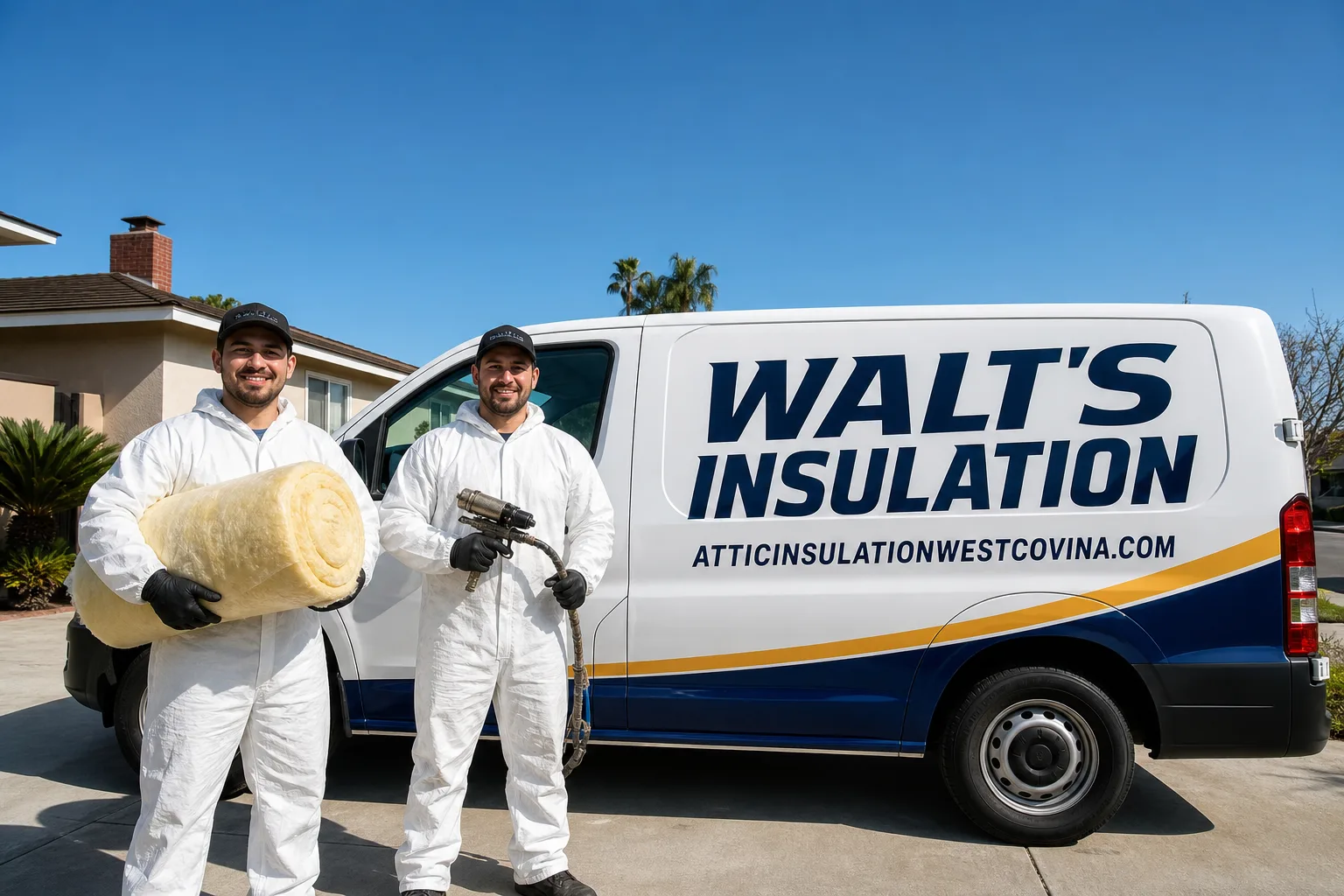
How Much Does Blown-In Insulation Cost in West Covina, CA?
Blown-in insulation in West Covina typically costs between $1,200 and $3,800 for a standard attic job, with most homeowners landing somewhere around $1,800 to $2,400. The final number depends on your attic’s square footage, current insulation levels, and whether you need air sealing or removal work done first.
We’ve been pricing and installing Blown-In Insulation services in West Covina and the surrounding San Gabriel Valley since 2000, and those ranges hold up across the vast majority of the homes we see – single-story ranches near Shadow Oak Park, two-story colonials off Amar Road, and older bungalows in the Merced Avenue corridor. If your home falls outside that range, we’ll tell you exactly why before we touch anything.
Blown-In Insulation Cost Breakdown (2026)
Blown-in insulation in West Covina costs $1.10 to $2.20 per square foot installed, depending on material type, target R-value, and site conditions. Here’s how that plays out across the most common job types we complete in West Covina:
| Job Type | Typical Scope | Estimated Cost Range |
|---|---|---|
| Attic top-up (fiberglass blown-in) | 1,000-1,500 sq ft, adding to R-11 existing | $800 – $1,600 |
| Attic full install, fiberglass blown-in | 1,000-1,500 sq ft, bare deck to R-38 | $1,200 – $2,200 |
| Attic full install, cellulose blown-in | 1,000-1,500 sq ft, bare deck to R-38 | $1,100 – $2,000 |
| Larger attic, fiberglass blown-in | 1,500-2,500 sq ft, bare deck to R-38 | $1,800 – $3,400 |
| Larger attic, cellulose blown-in | 1,500-2,500 sq ft, bare deck to R-38 | $1,600 – $3,000 |
| Dense-pack wall insulation (blown-in) | Per 100 sq ft of wall cavity | $350 – $700 |
| Old insulation removal before install | 1,000-1,500 sq ft attic | $600 – $1,400 |
| Air sealing added to blown-in job | Standard attic, penetrations sealed | $300 – $700 |
| Radiant barrier added to blown-in job | 1,000-1,500 sq ft attic | $400 – $900 |
A few things pull jobs to the higher end of those ranges in West Covina specifically. Homes built before 1980 – and there are a lot of them in the neighborhoods around Vincent Avenue and Hollenbeck Street – often have older knob-and-tube wiring or inadequate attic ventilation that needs to be addressed before installation begins. That adds cost, but skipping it is not something we’re willing to do. We’d rather give you an honest price upfront than have to explain a callback later.
On the material side: we install blown-in products from Owens Corning, Johns Manville, Knauf, and GreenFiber, among others. Fiberglass blown-in (like Owens Corning AttiCat) tends to cost slightly more per bag but settles less over time. Cellulose (like GreenFiber) is often the more cost-efficient choice per R-value, and it performs well in West Covina’s climate. We’ll tell you which one makes more sense for your specific attic before we quote you a number.
What Does R-38 Mean, and Is That the Right Target for West Covina?
California’s Title 24 building standards require a minimum of R-38 in attic applications for most West Covina homes. In practice, many homes we assess in West Covina are sitting at R-11 or less – especially houses built between 1955 and 1975, which make up a large share of the housing stock near the Eastland area and along Cameron Avenue. Getting from R-11 to R-38 is the most common scope of work we quote, and it’s usually achievable in a single day without disrupting the rest of the house.
If your home runs particularly hot in summer – which is real in West Covina, where July and August regularly push into the mid-90s in exposed neighborhoods closer to the 10 freeway – we sometimes recommend going to R-49. The additional material cost is modest (typically $200 to $400 more), and the payback on cooling bills is real.
What Affects Blown-In Insulation Pricing in West Covina
- Attic square footage and access difficulty: The bigger the attic, the more material and labor time required. Low-pitch rooflines – common on post-war ranch homes throughout West Covina – can slow installation significantly because technicians have less clearance to move and position hoses. Jobs that take twice as long in a cramped attic versus an open one are priced accordingly, and we’ll flag this during the walkthrough.
- Current R-value and what’s already up there: If there’s existing insulation in acceptable condition, a top-up is far less expensive than a full removal and reinstall. If the existing material is contaminated (rodent droppings are not uncommon in older West Covina attics, particularly near the hillside areas off Sunset Avenue), we won’t blow new insulation over it. Removal has to happen first – and that cost is real, but so is the alternative.
- Material choice – fiberglass versus cellulose: Both are legitimate options. Cellulose is often $0.10 to $0.20 per square foot less expensive. Fiberglass blown-in from manufacturers like Owens Corning or Johns Manville tends to resist moisture slightly better, which matters in crawl spaces and for homes near Walnut Creek channel where ground moisture is occasionally a factor. We’ll explain the tradeoff and let you decide.
- Air sealing scope: Blown-in insulation works dramatically better when air leaks at penetrations – recessed lights, plumbing chases, HVAC boots – are sealed first. We strongly recommend combining the two, and the cost adder is usually $300 to $700. Skipping air sealing and just piling on more insulation is like adding blankets to a drafty room – it helps, but not as much as it should.
- Removal of existing material: Wet, degraded, rodent-contaminated, or asbestos-era insulation has to come out before new material goes in. In West Covina, we see degraded vermiculite and older fiberglass batts in homes from the 1960s fairly regularly. Removal in a standard 1,200 sq ft attic runs $600 to $1,400 depending on the type and condition of material.
- Add-on services during the same visit: When we’re already in the attic with equipment staged, it’s the most cost-efficient time to add a radiant barrier or address attic ventilation. Combining services on one mobilization saves you money compared to scheduling two separate jobs. We’ll price it both ways and let you compare.
- West Covina’s climate demands: The San Gabriel Valley runs hot. West Covina sits at roughly 500 feet elevation, which gives it slightly less coastal influence than communities closer to the ocean. Summer attic temperatures in uninsulated or under-insulated homes can reach 140°F or more. That heat load means we’re often recommending R-49 rather than just Title 24’s R-38 minimum – it’s a modest upcharge with a real impact on cooling costs from June through October.
How to Save on Blown-In Insulation in West Covina
There are a few practical ways to reduce what you pay without cutting corners on the work itself.
Use Utility Rebates and Energy Credits
Southern California Edison and SoCalGas both offer rebate programs for insulation upgrades, and as of 2026, the federal Inflation Reduction Act’s energy efficiency tax credit still allows homeowners to claim 30% of the cost of qualifying insulation improvements, up to $1,200 per year. That credit applies to material and installation costs. A $2,000 blown-in job could net you $600 back at tax time. We’ll document the work in a format that makes the claim straightforward – just ask us when we’re there.
Combine Services on One Mobilization
If you’ve been thinking about air sealing, a radiant barrier, or attic cleaning alongside insulation, doing it all in one visit is meaningfully cheaper than separate jobs. The equipment is already on site, the technicians are already in the attic. We price combined jobs with that in mind, and we’ll show you exactly what bundling saves.
Don’t Wait Until There’s a Problem
Homeowners who call us after an unusually brutal August utility bill are in the same position as homeowners who put off a dental cleaning until there’s a cavity. The insulation isn’t going to improve on its own. In West Covina, where summer cooling costs are a real budget line item, upgrading sooner rather than later means you start capturing savings on the next billing cycle, not the one two years from now.
Get a Free Second Opinion
We offer a free second opinion on any written estimate – no trip charge, no obligation. If another contractor has given you a quote that seems high, or a quote that seems suspiciously low, bring it to us and we’ll walk through it line by line. We’d rather earn your business by being straight with you than win it with a number we can’t back up.
Ask About Our Standing Discounts
We offer a permanent 10% discount for seniors and veterans – always, not just during promotions. And if you have a repair that hits $200 or more, there’s $40 off applied automatically. These aren’t limited-time offers; they’re part of how we do business.
For a free, no-pressure estimate specific to your home and attic in West Covina, call (626) 612-1532. A live person picks up every time – no voicemail, no answering service, no waiting until Monday morning.
Blown-In vs. Batt Insulation in West Covina: Which Costs Less?
This question comes up a lot, so it’s worth a direct answer. Fiberglass batts are generally less expensive per square foot of material – but they’re rarely the better value in an attic context. Blown-in insulation fills around obstructions (HVAC ducts, wiring, cross-members) and reaches corners and edges that batts simply don’t cover well. In West Covina attics, where many homes have non-standard framing from mid-century additions, blown-in almost always delivers better real-world thermal performance than batts at the same R-value rating.
The installed cost difference between batt and blown-in in West Covina is typically $0.10 to $0.30 per square foot – often less than homeowners expect. Given the better coverage and the labor savings from not having to cut and fit individual batts around every obstruction, blown-in is usually the smarter call for attic applications. For walls, dense-pack blown-in is often the only practical option in existing construction without tearing out drywall.
For a full breakdown of our West Covina service options, visit our Blown-In Insulation in West Covina page.
Who Installs Blown-In Insulation in West Covina?
Walt’s Insulation has been serving West Covina homeowners since 2000. Walt Brenner leads every job – not in the sense of a franchise owner who checks in occasionally, but an owner who knows the local housing stock, knows which neighborhoods have older wiring configurations, and knows that a homeowner on Vine Avenue has different attic geometry than a homeowner in the Cortez Park area.
Every technician we send is background-checked and arrives in uniform. You’ll know who’s walking into your house. If anything about the job changes from what we quoted – scope, cost, timeline – you hear about it before we proceed, not after. That’s not a policy statement, it’s just how Walt built the business.
The home page gives you the full picture of what we cover across our service area, if you’d like to look around first.
Our Done Right Promise covers every blown-in insulation job we complete: if the work isn’t right, we come back and make it right. No runaround, no “that’s not covered.” Lifetime workmanship, real accountability.
FAQs – Blown-In Insulation Cost in West Covina
How much does blown-in insulation cost per square foot in West Covina?
Blown-in insulation in West Covina costs $1.10 to $2.20 per square foot installed, depending on material type (fiberglass vs. cellulose), target R-value, and site conditions. Cellulose runs slightly less per square foot; fiberglass blown-in from brands like Owens Corning or Johns Manville is typically at the higher end of that range. Call (626) 612-1532 for a free estimate based on your actual attic dimensions.
Is it worth adding blown-in insulation in West Covina’s climate?
Yes, and the payback is faster here than in milder climates. West Covina summers regularly push into the mid-90s, and attic temperatures in under-insulated homes can exceed 130°F. Upgrading from R-11 to R-38 typically reduces cooling-related energy use by 20% to 35% in the San Gabriel Valley, according to Energy Star estimates. Combined with the 30% federal tax credit available through 2032, most homeowners recoup the cost within 3 to 6 years. Call (626) 612-1532 if you’d like us to run the numbers for your specific home.
How long does blown-in insulation installation take in West Covina?
Most standard attic jobs in West Covina take 3 to 6 hours for a single-story home with straightforward access. Larger homes, tight attic clearances (common in older ranch-style homes in West Covina), or jobs that include removal and air sealing can run a full day. We’ll give you a realistic time estimate before we start – not the optimistic version.
Does blown-in insulation in West Covina require a permit?
In most cases, no permit is required for attic insulation top-ups or replacements in West Covina under current City of West Covina building codes. However, if the scope includes structural modifications, electrical work, or new attic ventilation, a permit may apply. We handle the permit question as part of every job assessment and will tell you exactly what applies before work begins.
Should I repair or replace my existing blown-in insulation?
If your existing insulation is structurally intact and uncontaminated, a top-up is usually the right call – and costs significantly less than full removal and reinstall (often $400 to $800 less for a typical West Covina attic). If there’s rodent activity, moisture damage, or the material is degraded beyond a certain point, replacement is safer and more cost-effective long-term. We assess this during every free estimate and give you our honest read. Call (626) 612-1532 – a live person will answer and can walk you through the next step.
Can you install blown-in insulation the same day I call?
We can often schedule West Covina jobs within 1 to 3 business days, and in some cases the same week as your initial estimate. Emergency attic situations (active heat damage, post-rodent cleanup) are prioritized. Call (626) 612-1532 any time – our phones are answered 24/7 by a live person who can check the schedule right then.
Key Takeaways
- Blown-in insulation in West Covina costs $1,200 to $3,800 for most attic jobs, with the average landing around $1,800 to $2,400.
- California Title 24 requires R-38 minimum for attics; in West Covina’s hot summers, R-49 is often the smarter investment.
- Cellulose (GreenFiber) and fiberglass blown-in (Owens Corning, Johns Manville, Knauf) are the two main options – each has a clear use case, and we’ll explain which fits your attic.
- Combining blown-in with air sealing on one visit delivers better thermal performance and saves money compared to two separate jobs.
- The 30% federal energy efficiency tax credit applies to qualifying blown-in insulation jobs through 2032 – ask us for the documentation you’ll need.
- We offer a free second opinion on any written estimate, no trip charge in our service county, and a permanent 10% discount for seniors and veterans.
- Every job is covered by the Done Right Promise: lifetime workmanship, no runaround.
Get a Free Estimate for Blown-In Insulation in West Covina
If your home is under-insulated, you’re paying for it every month on your cooling bill – and every summer in West Covina is a reminder of that. Walt Brenner and the team at Walt’s Insulation have been doing this work in the San Gabriel Valley for over 25 years, and we’re straightforward about what a job actually costs and what it will actually do for your home.
Call (626) 612-1532 for a free estimate. Someone picks up every time – day, night, weekends. No voicemail, no call center, no waiting. If you’ve already got a written quote from another contractor, bring it to us and we’ll give you a free second opinion with no obligation. That’s not a sales tactic – it’s how we’d want to be treated if we were in your position.
Walt’s Insulation. The one down the road.
Pricing reflects the West Covina market as of 2026. Walt’s Insulation offers free estimates – call (626) 612-1532.
Written by Walt Brenner, Owner at Walt’s Insulation, serving West Covina since 2000.
What Our Customers Say
"Walt came out himself, stuck his head in the attic, and told me I had about four inches where I needed fourteen. No sales pitch, just the number and what it would cost to fix it. Crew was here two days later."
- Carl Meadows"The house had rats in the attic insulation and a smell we could not place. Walt's crew pulled all of it, sealed the gaps where they were getting in, sanitized, and put in new blown-in. He sent photos of the sealed openings so I could see it done."
- Rosa Delgado"Radiant barrier and new insulation in one visit. Walt explained what the foil actually does and what it does not, which nobody else bothered to. Electric bill in July was the lowest it has been in this house."
- Nadia Haddad